
Worldwide market leader
Eyelink belts
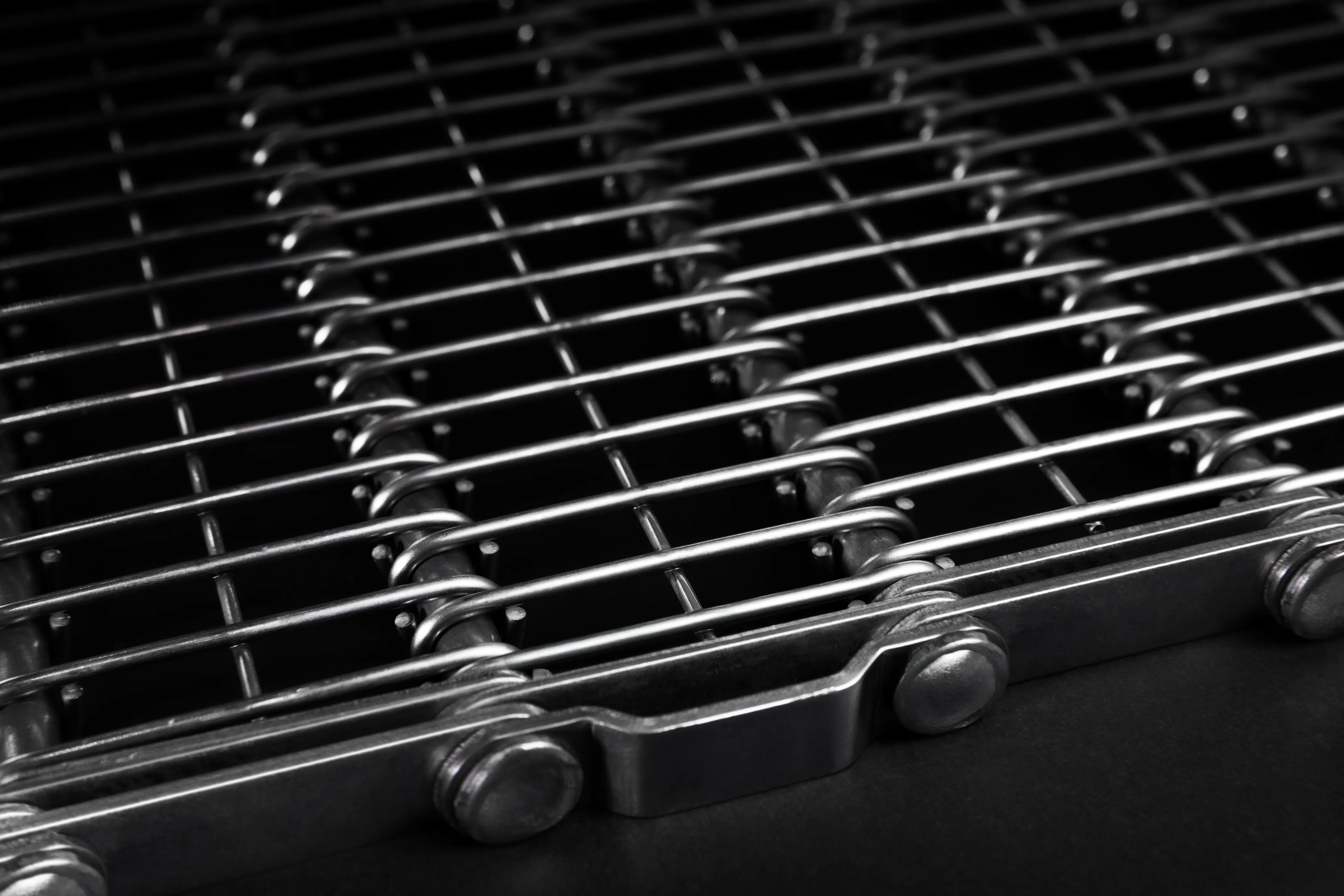
A flat, stable and durable conveying surface. Twentebelt is the worldwide market leader in Eyelink belts - combining the dimensional stability of metal with positive (form-fit) drive and easy cleaning.
- Pitch
- 15.9 - 76.2 mm
- Wire diameter
- 1.6 - 3.2 mm
- Cross pitch
- 3 - 50 mm
- Temp. (AISI 304/316)
- -80 … +350 °C
An Eyelink belt is built from precisely calibrated eyelinks, plate links and cross rods. Linking the eyes onto the rods creates a hinged construction - a flat, straight surface that is exceptionally stable and durable.
The single-level surface eliminates the tunnel effect - products do not get trapped between belt layers, and air and liquid drainage is excellent. Low build height, 24/7 durability and modular construction (easy section repair) make Eyelink a versatile solution for the food, chemical, pharmaceutical and packaging industries.
Flat, stable surface
Continuous product support = consistent end result and minimal marking.
No tunnel effect
Single-level weave - products don't get trapped, excellent drainage.
Positive (form-fit) drive
Sprockets guarantee perfectly straight tracking without slippage.
Modular repair
Replace the damaged section, not the whole belt - less downtime.
Technical specification
| Construction | eyes + plate links + cross rods (hinge) |
|---|---|
| Pitch | 15.9 - 76.2 mm |
| Wire diameter | 1.6 - 3.2 mm |
| Cross pitch (eye spacing) | 3 - 50 mm |
| Number of locating wires | 0 - 8 |
| Max. speed | 25 m/min (peak up to 60 m/min) |
| Materials | steel (bright), AISI 304, AISI 316 |
| Temp. steel (bright) | 0 … +220 °C |
| Temp. AISI 304 / 316 | -80 … +350 °C |
| Food contact | Yes (approved materials) |
Versions and construction types
Full eyes
Base version; opening equal to the wire diameter. For products prone to falling through.
Pressed eyes
Flattened eyes = smallest possible opening. For small, delicate products.
Welded eyes (modular)
Eyes welded to a locating wire - a module. Very narrow or wide openings, EU/US assembly.
Pressed + welded
Stable belt with a small opening/drainage; very wide belts possible.
With springs
Lightweight belt with good resistance to impact and side forces (manual/side loading).
With sleeves/spacers
Heavier and stiffer; sleeves/spacers create a fixed opening.
Edge finishing
- LK Welded edge Plate links + welded spacers on the rod ends - a solid finish.
- KH Side chain Hollow-pin for negative bends (freezing, blanching, incline belts).
- GP Guide plates Buffer protecting the welded heads against the guides.
- KB Plastic blocks (patented) Weld-free (bolted), smooth hygienic edge; Ryton PPS version up to +180 °C.
Drive
- Sprockets driving on the eyes (or on the rod at large cross pitch)
- Cage rollers - for wide and heavily loaded belts
- Disc rollers - where ice/dirt build-up is a risk
- Tube drum - the strongest, limits deflection
- Chain sprockets (recommended ≥ 12 teeth - minimises the polygon effect)
Options
- Edge plates (control of product layer thickness)
- Flights for incline/decline belts
Most common Eyelink belt dimensions
| Pitch [mm] | Wire Ø [mm] | Rod Ø [mm] | Min. eye spacing [mm] |
|---|---|---|---|
| 15.9 | 1.6 | 3.2 | 3.25 |
| 15.9 | 2.0 | 4.0 | 4.05 |
| 25.4 | 2.5 | 5.0 | 5.05 |
| 38.1 | 3.0 | 6.0 | 6.05 |
| 50 / 50.8 | 3.2 | 6.4 | 6.45 |
| 75 / 76.2 | 3.0 | 10 - 13 | 6.05 |
Example designation: DL-LK 6-50-2.5-5 (cross pitch 6, pitch 50, wire Ø 2.5, rod Ø 5). Non-standard specifications are possible.
Materials
Applications
Frequently asked questions
How do you clean an Eyelink belt?
The materials are approved for food contact. For stainless steel, caustic soda and citric acid (or another suitable agent) are used. Note: SS belt + carbon-steel chain combinations must be cleaned with steam/hot water only - citric acid corrodes carbon steel.
How is an Eyelink belt driven?
By positive (form-fit) drive - sprockets directly on the eyes (or on the cross rod at large cross pitch), cage/disc rollers or a tube drum. This guarantees no slippage and straight tracking.
What about a negative bend (e.g. freezing)?
We use side chains (KH) with a hollow pin and wide-radius guides to avoid point loads in the locating-wire zone.
Where Eyelink performs
Typical processes and industries where we recommend this belt family.
Related constructions
Maximum flow
Wire Mesh
Large openings and minimal product contact. Small turning radius = excellent transfer. FDA / GMP / EC 1935/2004 compliant.
The mother of all metal belts
Spiral Woven
The most versatile weave - from heavy, hot products to fine goods. Rod Reinforced type up to +1200 °C. Perfectly round edge = clean transfer.
We'll match Eyelink to your process
Send your application parameters (product, temperature, width, environment) and we'll prepare a specification and quotation for a Twentebelt belt.