
Maximum flow
Wire Mesh belts
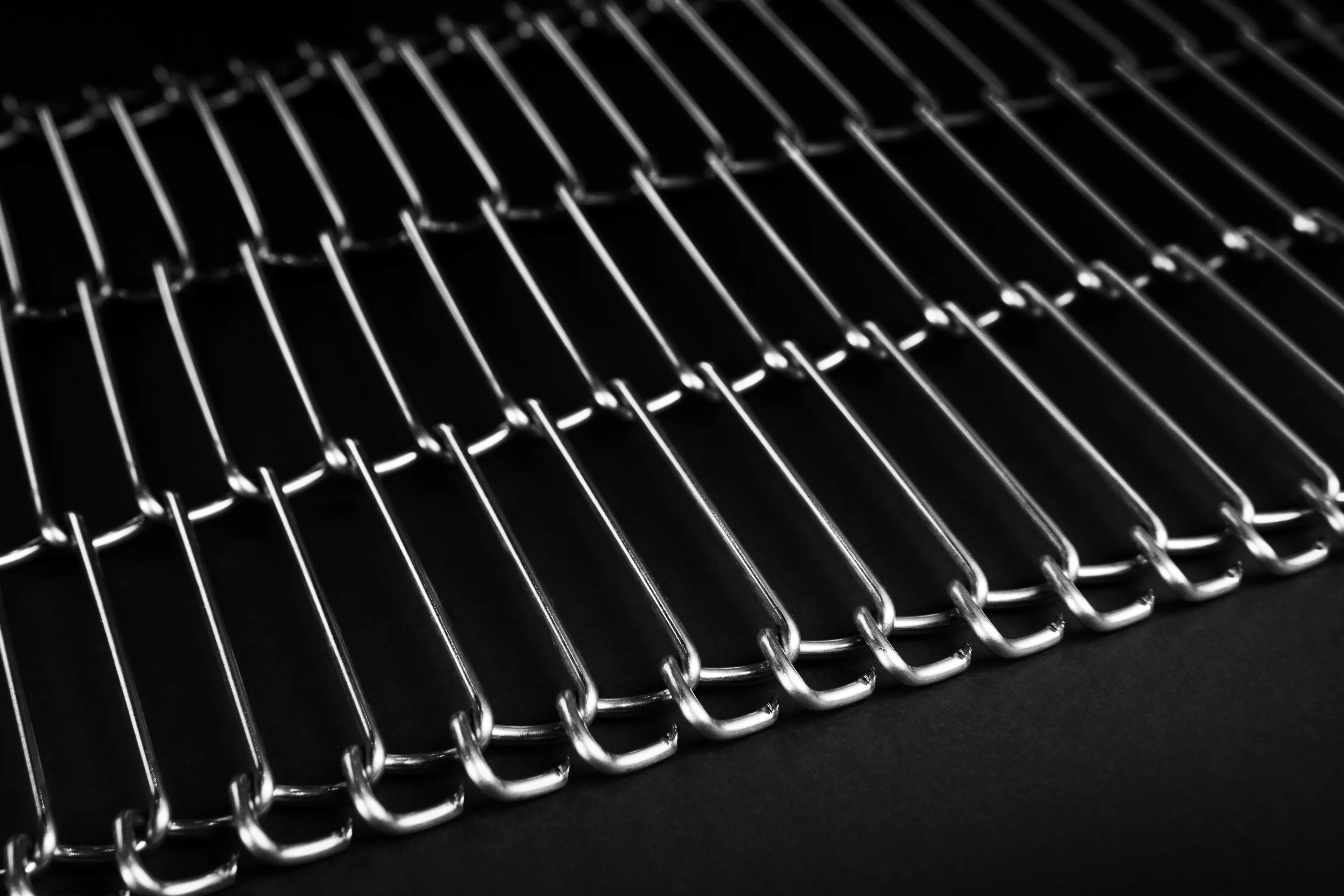
Very large openings and minimal product contact - ideal for enrobing, glazing and breading light products. Low weight = lower energy consumption.
- Pitch
- 3.5 - 28 mm
- Wire diameter
- 0.9 - 2.8 mm
- Mesh width
- 40 - 150 mm
- Materials
- AISI 302 / 316
Wire Mesh belts are a rod-network construction - high-quality homogeneous wires linked by cross rods, produced on machines designed by Twentebelt. Very large openings give the product minimal contact with the belt - making them ideal for coating processes: chocolate enrobing, egg glazing and breading.
The belt turns on a very small radius, ensuring excellent transfer of light products. Low self-weight means lower energy consumption and less heat absorption in heating applications, while the open structure with no hidden gaps makes cleaning easy.
Very large openings
Minimal product contact - ideal for coating and light products.
Small turning radius
Excellent, clean transfer of the product to the next stage.
Low weight = energy efficiency
Lower energy consumption and less heat absorption.
Easy cleaning
No hidden gaps; FDA, GMP and EC 1935/2004 compliant.
Technical specification
| Construction | wires linked by cross rods (rod network) |
|---|---|
| Pitch | 3.5 - 28 mm |
| Wire diameter | 0.9 - 2.8 mm |
| Mesh width | 40 - 150 mm |
| Materials | AISI 302, AISI 316, spring steel, music wire |
| Edge finishing | S (GR-SK) or double Z (GR-ZK) |
| Food safety | FDA · GMP · EC 1935/2004 |
| Drive | sprockets / discs (never from the carrying side) |
| Conveyor curves | available (90°) |
Versions and construction types
Single S edge
Standard single S loop.
Double Z edge
Double-bent Z loop - additional gear-wheel edge.
Drive
- Sprockets or discs in stainless steel / plastic
- Sprocket width = mesh width minus 10 mm
- Never drive from the carrying side (the belt skips the teeth)
Options
- Flights and levels for fixed product spacing
- Tips and integral spacer profiles
- Endless joining: segments / woven-in rod / connection tubes
Standard Wire Mesh range
| Wire Ø [mm] | Min. S edge [mm] | Min. mesh [mm] | Type |
|---|---|---|---|
| 0.90 | 4 | 40 | SK / ZK |
| 1.20 | 4 | 40 | SK / ZK |
| 1.40 | 5 | 45 | SK / ZK |
| 1.60 | 6 | 50 | SK |
| 2.00 | 8 | 50 | SK |
| 2.35 | 10 | 65 | SK |
| 2.80 | 12.5 | 80 | SK |
Example designation: GR-SK 8 - 5×76.8 - 8 - 10 - 1.6. Pitch 3.5-28 mm, mesh 40-150 mm. Non-standard specifications on request.
Materials
Applications
Frequently asked questions
Are Wire Mesh belts food safe?
Yes - they are manufactured to current requirements: FDA, GMP and the EC 1935/2004 framework regulation. The open structure with no hidden gaps makes cleaning easy.
How is a Wire Mesh (rod) belt driven?
By sprockets or discs (stainless steel or plastic) placed under the odd sections of the belt. Never drive from the carrying side, because the belt skips the teeth.
How do you make the belt endless?
Three methods: joining individual segments, weaving in a rod, or using connection tubes. The choice depends on the mesh type and application.
Where Wire Mesh performs
Typical processes and industries where we recommend this belt family.
Processes
Related constructions
Worldwide market leader
Eyelink
Flat, stable surface with positive (form-fit) drive. The single-level weave eliminates the tunnel effect. Twentebelt is the worldwide leader in this construction.
Innovation in spirals
TwenteFlex™
Weld-free spiral with a bent rod - the end of cracking welds and sharp edges. Hygienic, easy to clean. Full Metal or POM/PA6 hybrid version.
We'll match Wire Mesh to your process
Send your application parameters (product, temperature, width, environment) and we'll prepare a specification and quotation for a Twentebelt belt.